
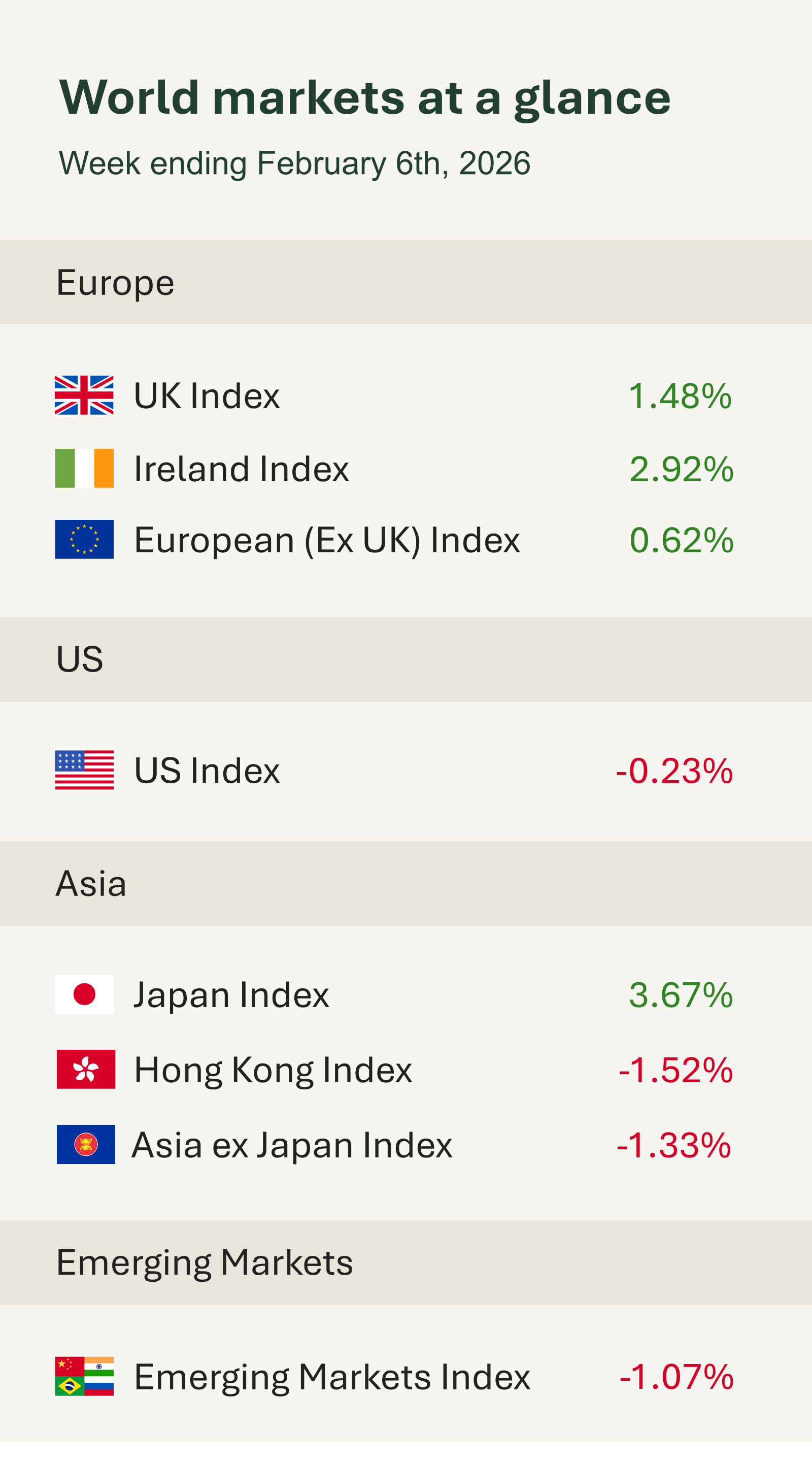
Week ending 6th February.

As shown in the accompanying table, global equity markets delivered mixed results over the week, with UK and European markets outperforming the US. Market performance was influenced by a combination of uneven corporate earnings and ongoing geopolitical uncertainty.

Technology stocks were a key source of market weakness earlier in the week. Concerns around the disruptive potential of artificial intelligence, alongside questions about whether current investment levels can be justified by future profitability, weighed on sentiment. Even as companies delivered robust earnings, Big Tech’s aggressive AI spending plans present a challenge for investors. While Friday’s rebound helped stabilise near-term sentiment. The Dow Jones Industrial Average rose 2.47%, while the S&P 500 and Nasdaq Composite gained 1.97% and 2.18%, respectively. Despite this late-week rally, overall weekly performance remained mixed, with the S&P 500 edging down 0.1% and the Nasdaq declining 1.8%.

The STOXX Europe 600 rose 1.00% as optimism around the eurozone outlook improved. The UK’s FTSE 100 gained 1.43%, supported by valuation appeal and defensiveness. Japanese equities outperformed, with the TOPIX gaining over 3.5 %, driven by positive domestic sentiment ahead of the February election.

In the UK the Bank of England’s Monetary Policy Committee voted to hold interest rates at 3.75%, following a closely split decision. Five members supported holding rates, while four voted for a 0.25% cut.

Governor Andrew Bailey voted to keep rates unchanged but noted that he could “see scope for some further easing of policy.” He reiterated his view that inflation, measuring the pace of price growth, is expected to fall close to the Bank’s 2% target from spring onwards, earlier than the previous expectation of 2027.

“That’s good news,” Bailey said. “We need to make sure that inflation stays there. All going well, there should be scope for some further reduction in the Bank Rate this year.”

Lower interest rates reduce the cost of capital for businesses and make borrowing more affordable for consumers, supporting demand through cheaper mortgages and loans. However, this easing also tends to weigh on returns for savers.

Further easing would therefore provide a welcome boost to both corporate activity and consumer demand, factors that are generally supportive for markets.

Also on Thursday, as widely expected, the European Central Bank held interest rates steady for a fifth consecutive meeting, keeping the deposit rate at 2%.

ECB President Christine Lagarde noted that the eurozone economy “remains resilient in a challenging global environment.” She highlighted low unemployment, solid private‑sector balance sheets, the gradual rollout of public spending on defence and infrastructure, and supportive financing conditions as key factors underpinning growth.

However, the outlook remains uncertain, with ongoing trade policy uncertainty and geopolitical tensions posing risks. Policymakers are seen as being in no hurry to cut rates. January inflation printed slightly below expectations, with headline inflation at 1.7% year on year and core inflation easing to 2.2%, supporting expectations that underlying price pressures are continuing to moderate.

In Japan, markets reacted positively to a landslide election victory of Japanese Prime Minister Sanae Takaichi’s coalition on Sunday. The ruling coalition secured a commanding majority in the 465‑seat lower house, winning 352 seats, in what local media described as a historic result. Japanese equities rallied sharply on the news, pushing the market to a record high as investors welcomed the clear political mandate.

Looking ahead to next week, the data calendar is busy on both sides of the Atlantic. In the UK, the focus will be on retail sales, Q4 2025 GDP, and industrial production. In the US, investors will be watching retail sales, industrial production, the unemployment rate, non-farm payrolls, and average earnings. Inflation data from the US and the European balance of trade will also be in focus.

Kate Mimnagh, Portfolio Economist

The latest market updates are brought to you by Investment Managers & Analysts at Wealth at Work Limited which is a member of the Wealth at Work group of companies.

Links to websites external to those of Wealth at Work Limited (also referred to here as 'we', 'us', 'our' 'ours') will usually contain some content that is not written by us and over which we have no authority and which we do not endorse. Any hyperlinks or references to third party websites are provided for your convenience only. Therefore please be aware that we do not accept responsibility for the content of any third party site(s) except content that is specifically attributed to us or our employees and where we are the authors of such content. Further, we accept no responsibility for any malicious codes (or their consequences) of external sites. Nor do we endorse any organisation or publication to which we link and make no representations about them.